

Loop-ah™: 10-Lever ARR Engine
Refillable hotel shower hygiene with recurring plant-based cartridges under contract; the dispenser is a simple one-time line.
The co-operative network activates 10 revenue levers across supply, rollout, and ESG alignment—compounding durable, contract-backed cash flows while reducing operational risk for partners.
Contracts set ACV; replenishment cadence sets ARR. Revenue is recognized on delivery/shipment (not tied to guest adoption or usage).

Investor FAQs
Quick answers to the most common investor questions—kept simple and consistent with Loop-ah’s contract-first replenishment model.

How does Loop-ah recognize revenue?
What is recurring vs one-time?
What is the prototype-first raise for?
What does the paid pilot look like?
How do hotels buy Loop-ah?
What are the headline economics?
Prototype Round: $250K–$300K to finalize pilot-ready cartridges + dispenser
Use of funds below shows a $300K plan within the $250K–$300K range to deliver a pilot-ready Loop-ah™ system for a controlled paid pilot scoped after intake, with a mutually agreed room cohort and a defined measurement window. Each room requires one wall-mounted dispenser.

What this prototype round enables
- Pilot-ready system across the cartridge/tape + dispenser (repeatable builds, not a one-off demo).
- Installed paid pilot in an agreed room cohort (one dispenser per room), with replenishment workflow proven.
- Portal v1 for ordering + KPI reporting to support operator rollout decisions.
- Operational readiness for portfolio deployment and seed tranche gating (M1–M3).
Pilot KPIs we track
- Usage/room/day and cartridge refill cadence.
- Stockouts ≤2% and delivery OTIF.
- Minutes saved/room and reduced wash cycles.
Seed tranche triggers (M1–M3)
- M1 — MVP live, training complete, pilot running with a mid-to-large portfolio.
- M2 — Sufficient KPI data + installs across first portfolio to support a rollout decision.
- M3 — pilot conversions/LOIs + readiness for Phase 2 (Residential) entry.
Why Loop-ah Works as an Investment
Hotel leaders are asked to free up housekeeping time, curb laundry cycles, and hit ESG targets—without denting guest experience. Loop-ah meets that brief with a contract-first model: dispensers recognize once; cartridges repeat, so ARR, GM, and payback live in the cartridge line.
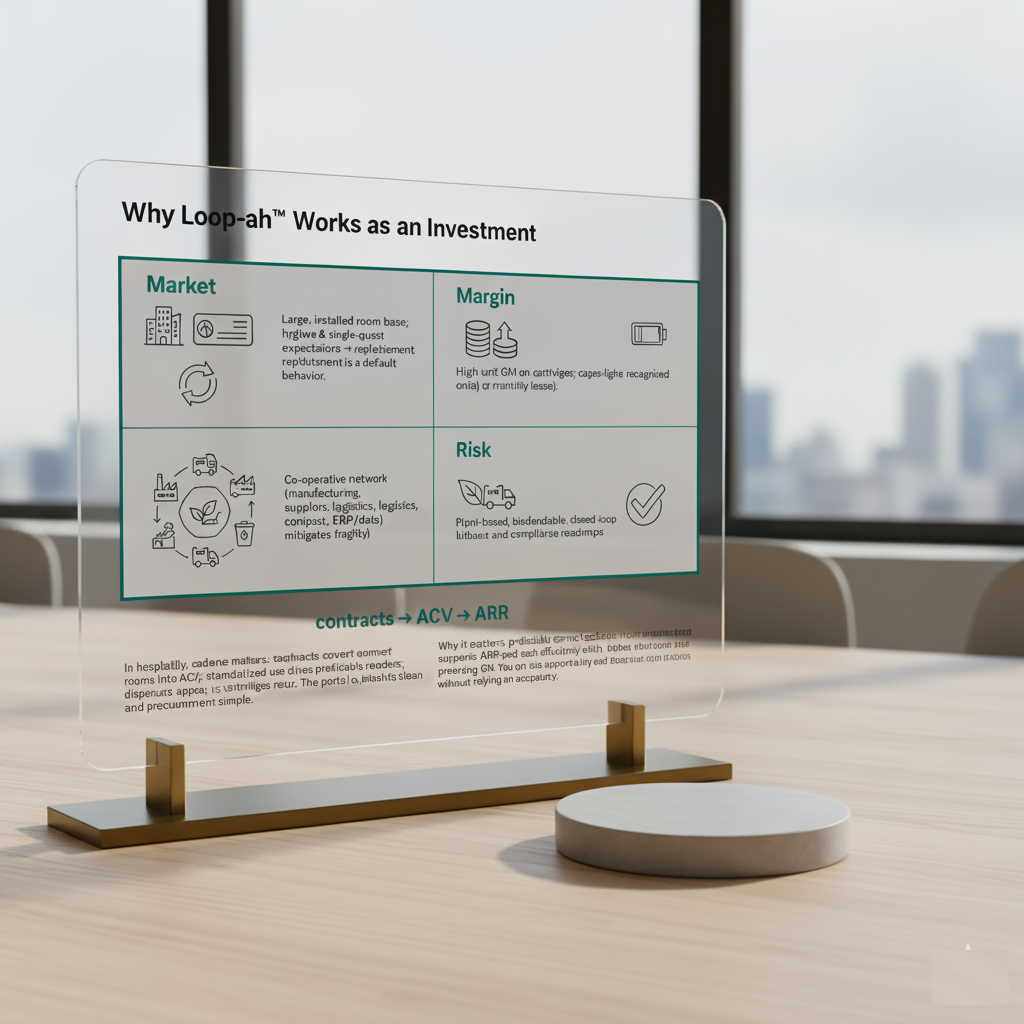
The day-to-day reality: extended droughts elevate water stewardship, net-zero paths push kWh & CO₂ reduction, and detergent discharge and textile waste face scrutiny. At the same time, managers need more guest-facing hours without more headcount.
Loop-ah replaces high-turn cloths with a plant-based, single-guest loofah tape in a clean, wall-mounted dispenser. Contracts set minimum room commitments; a portal sets cadence. The result is predictable ARR and high-GM refills that roll up cleanly from room → property → portfolio.
Market
Large, replaceable spend in hospitality; hygiene and convenience favor recurring refills.
Margin
High-GM cartridges repeat; dispensers recognized once (sale) or as lease MRR.
Risk
Co-op supply + compost network minimizes single-point failures as rooms under contract scale.
Fit
Plant-based, biodegradable system aligned with brand standards and compliance goals.
Up next: we translate this story into numbers for your footprint in Unit Economics & Margins—linking price, COGS, and cartridge cadence to GM%, ARR, and payback. Then we put the same footprint through Sensitivity & Stress Test to size resilience across Base / Bear / Bull.
Unit Economics & Margins
Contracts convert rooms into predictable ACV. Revenue is recognized upon cartridge delivery (ASC-606), so ARR and GP live in the cartridge line.
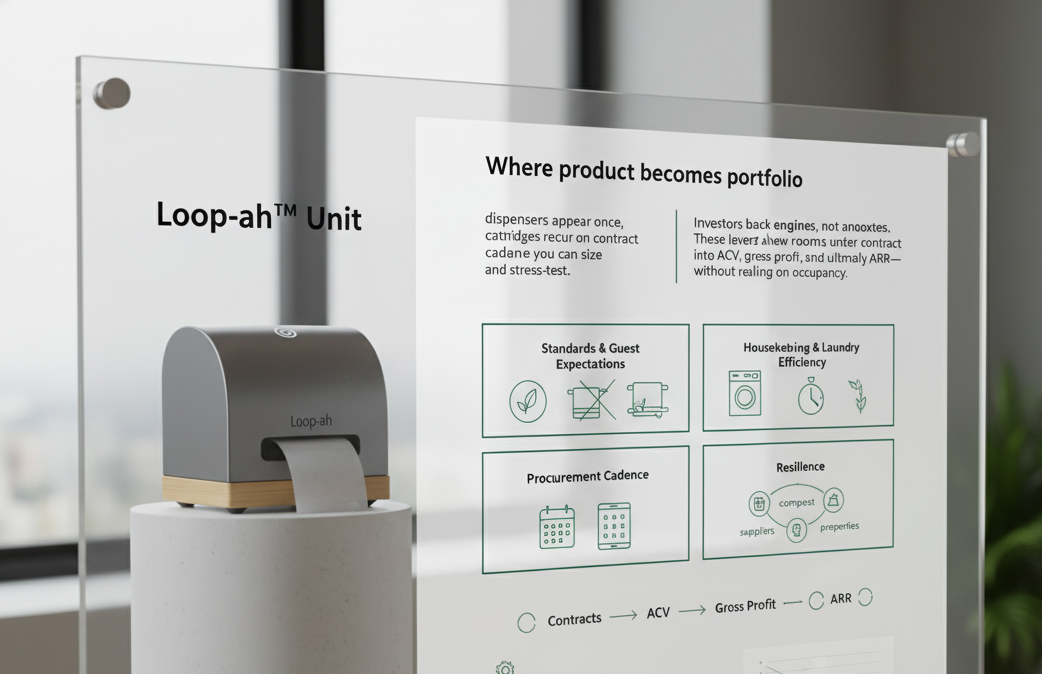
Controls
Outputs (current footprint)
Per-Room (derived)
Annual Recurring — Cartridges
Annual GP — Cartridges
Adjust the footprint to see ARR, GP, GM%, and payback (days) for your properties.
Sensitivity & Stress Test
Tap a scenario. Enter contracted rooms. Choose Custom to nudge ARR/room and GP/room ±%. Cartridge ARR and GP drive the model; hardware is incidental.

Controls
Adjust deltas (Custom)
Outputs (current rooms)
Cartridge — Unit GM%
Annual Recurring — Cartridges
Annual GP — Cartridges
Hardware GP Payback (days)
Enter contracted rooms and select a scenario to see GM%, ARR, GP, and payback.
5-Year Portfolio Projection
Enter contracted rooms for each year. Revenue recognizes on delivery:
rooms × carts/room/yr × price. Usage does not affect recognition.
Cartridge ARR and GP drive the model; the dispenser is a small one-time enabler that pays back quickly and then gets out of the way.
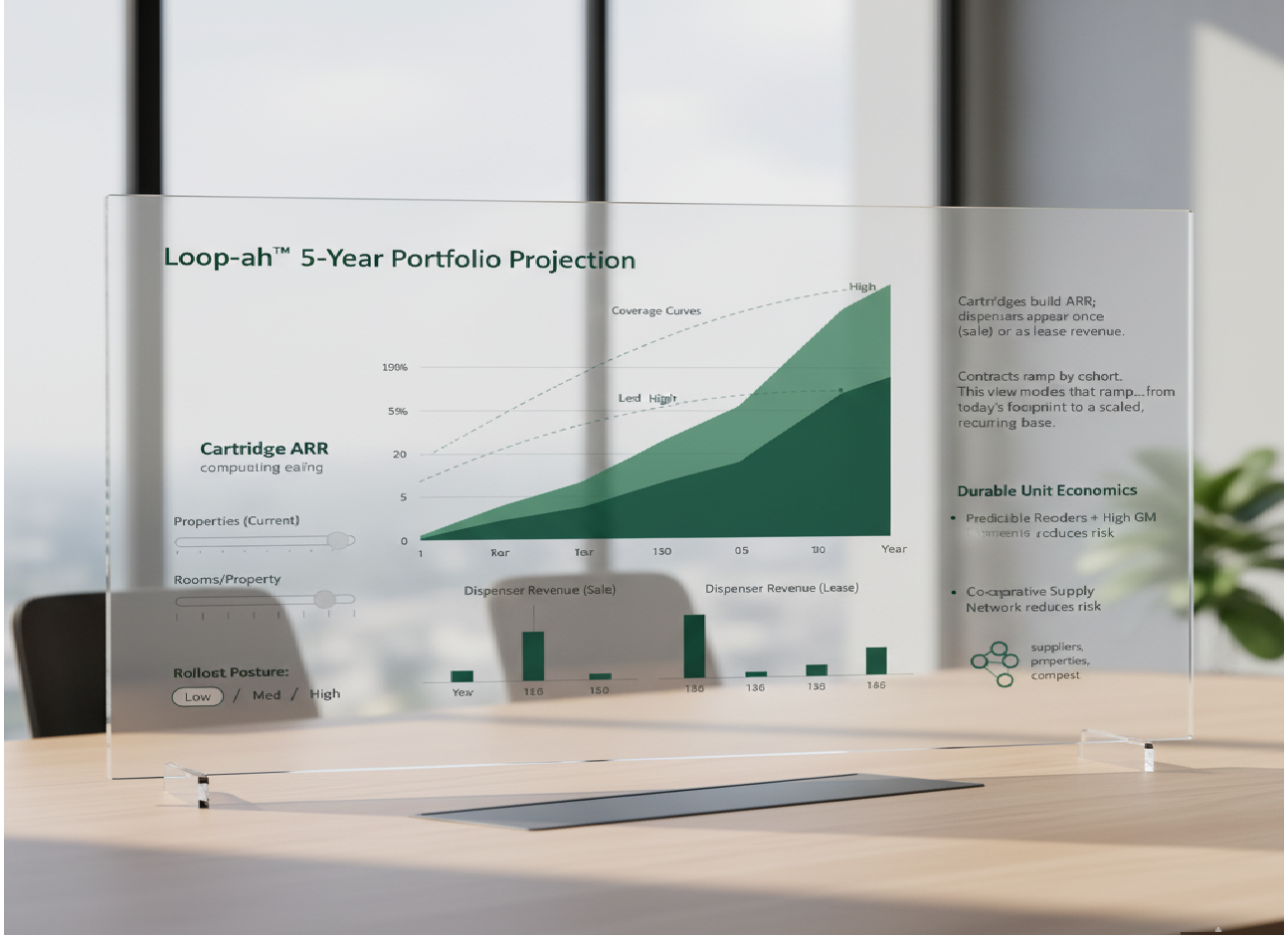
Contracted rooms per year
Outputs (Y1→Y5)
| Year | Contracted rooms | Total Cartridge ARR | Cumulative |
|---|
Enter contracted rooms per year to see cartridge ARR and cumulative portfolio value.
When rooms are entered, this line will summarize total contracted rooms through the selected year.